






New research: Domestic solar panel growth at its fastest since 2016
Posted by: electime 7th July 2023
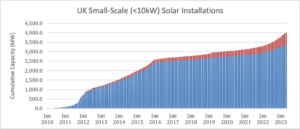 Research from NTT DATA UK&I finds that small-scale (<10kW) solar PV installations are growing at the fastest rate in almost seven years due to high energy prices – but capitalising on this opportunity may place excess demands on the UK’s national energy grid capacity.
NTT DATA UK&I, a leading IT services provider and industry consultancy, announced the results of its analysis into the installation of solar photovoltaic (PV) panels around the UK.
By analysing twelve years of data recently released by the UK government, NTT DATA UK&I found that the installation of household solar panels in the UK in 2022 made up 69 per cent of added solar capacity. However, due to thermal and voltage constraints on their networks, Distribution System Operators (DSOs) have a limit on how much new generation they can connect, threatening the future of the renewable energy system.
Key Points:
- Rising electricity costs and falling PV panel and battery costs are driving growth in small-scale (<10kW) solar PV installations in homes.
- In 2022, small-scale residential deployments accounted for 73 per cent of added solar capacity compared to the five-year average of 43 per cent.
- June 2022 was the first time since March 2016* (when Shotwick Solar PV Park, the UK’s biggest solar power station, came online), that domestic installations made up more than a quarter (26 per cent) of the UK’s solar capacity.
- The cumulative capacity of domestic solar PV installations now amounts to over 4.2 GW of generating capacity, following reports of underinvestment last year as solar farm plans were refused at the highest rate for five years in Great Britain.
- These findings may reflect the lack of tax relief for renewables investments compared to oil and gas – despite the government’s target of 70GW of solar capacity by 2035.
- The Smart Export Guarantee (SEG) only pays, on average, 4.9p/kWh – just over 13 per cent of the current wholesale price of 37.2p/kWh – incentivising solar PV owners to store excess energy in Distributed Energy Resources (DERs, or ‘batteries’) rather than selling and releasing it back to the national grid.
- As small-scale installations rise sharply, infrastructural reinforcement is needed so new microgeneration resources (i.e. residential solar PVs) can be integrated into the grid.
The cost of electricity has risen rapidly in the past 12 months**, driving sharp growth in residential solar panel installations in an effort to cut household bills. However, due to infrastructural constraints on the number of new generators that can be connected to the grid; a lack of investment in large-scale, industrial solar farms; and a low price average for energy sold back to the grid, it will be a challenge for networks to capture this spike in renewable energy sources.
The Smart Export Guarantee (SEG)***, which pays homeowners to deliver excess energy back to the grid, only pays around 4.9p/kWh – just over 13 per cent of the September 2022 wholesale price of 37.2p/kWh. As a result, homeowners with solar PV panels are incentivised to store their excess energy through DERs (‘batteries’) to maximise their investment. Despite the space and expense DERs command, research shows that small-scale residential installations are rising at a rate not seen in seven years.
Given that last year was the first time since March 2016 that small-scale installations made up over a quarter of the UK’s solar capacity, the ability to manage supply and demand more locally will lead to a smarter, more efficient energy grid (in a process known as DSO transformation) – reducing unnecessary carbon emissions and other wastage. However, this will require targeted government support as DSOs choose the most effective paths of investment to manage this uptick in generation capacity.
Eduardo Fernandez, Vice President, Gas, Power, and Water at NTT DATA UK&I, said: “Energy microgeneration has graduated from theory to practice: due, in part, to rapidly increasing energy prices. Renewed investment in solar installations by homeowners is driving the decentralisation of the energy grid and ramping up the pressure for DSO transformation. Our data shows that small installations now make up a quarter of the UK’s national solar capacity, with that figure rising rapidly, which puts pressure on DNOs to make drastic changes to their technology stack.
“However, the data shows that homeowners are now paid an average of around 4.9p/kWh to deliver excess electricity back to the grid. Wholesale prices paid by electricity companies are almost 10 times this, and the current energy cap is 9 times the price paid. This, along with a limited grid capacity for renewables, often contributes to solar PV owners installing DERs to store excess energy, making energy supply and demand more rigid and inefficient as electricity must be transmitted over greater distances to meet demand. Understanding consumer behaviour through data-driven insights like this will be key for energy networks to justify to investors why and where extra investment in grid reinforcement is needed.”
“By helping DSOs to take advantage of this movement and integrate distributed resources: we can maximise the impact of transformative technologies like IoT and intelligent automation to create smarter transmission and distribution networks, turning data from physical assets into actionable insight. This will create a smarter grid: granting greater control and better decision-making through the data provided by smart meters and IoT devices. The data insights show us that small-scale residential has the potential to be a meaningful participant in the National Grid.”


