






One in four UK drivers will buy electric next
Posted by: electime 14th July 2023
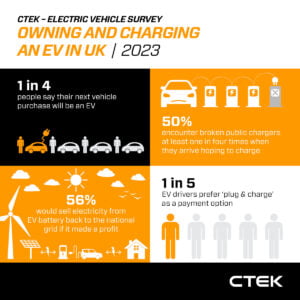 UK drivers are keen to switch to Electric Vehicles (EVs) in big numbers, with a CTEK survey by YouGov released today showing that almost one in four people (24 per cent) say their next vehicle will be a fully electric or plug-in hybrid EV.
But queues to charge and broken charge points are blighting EV driving, fuelling increased charger anxiety in the UK. The UK tops the chart of the five European countries surveyed for respondents agreeing there is not enough charging infrastructure for EVs.
More UK drivers intend to buy brand new EVs (12 per cent) than new Internal Combustion Engine (ICE) vehicles (9 per cent), according to the third annual survey by YouGov for the vehicle charging brand CTEK.
The 12 per cent planning to buy new EVs are split equally between opting for fully Battery Electric Vehicles (BEVs) and Plug-in Hybrid Electric Vehicles (PHEVs). For used vehicles, ICE (29 per cent) remains ahead of EVs (12 per cent – 4 per cent BEV and 8 per cent PHEV).
More than seven out of ten (71 per cent) current EV owners intend to buy BEV or PHEV again whilst 50 per cent of current ICE owners plan to stick with petrol or diesel and 25 per cent are looking to buy an EV. The over 55s are less likely to choose an EV than other age groups, and women (20 per cent) are less likely to do so than men (28 per cent).
Asked that if their EV and home charger enabled it, would they sell electricity from their EV battery back to the national grid if it made them a profit, 56 per cent of UK EV drivers said yes (including 64 per cent owning purely battery EVs) and another 19 per cent did not know.
Whilst the intention to go electric is strong, the survey identifies problems with public charging provision in all the surveyed countries.
Insufficient public charging is fuelling growing anxiety over topping up an EV’s battery. The 2023 survey found 76 per cent of UK people agreeing EV drivers have charger anxiety, up from 65 per cent in 2022. The 76 per cent was equalled only in France.
And a survey high of 83 per cent in the UK said there is not enough charging infrastructure, up from 71 per cent in 2022 and ahead of Sweden, Norway, France and the Netherlands.
Half of UK EV drivers (50 per cent) now encounter broken public chargers at least one in four times when they arrive hoping to charge. Some 6 per cent said charge points are always broken.
EV drivers who encounter faulty charge points most often do so at destinations such as shopping centres and leisure venues (30 per cent), in public car parks (21 per cent), on motorways and major highways (16 per cent) and near their home (12 per cent).
More than half (52 per cent) of UK EV drivers have to wait to use a public charger at least one in four times; 4 per cent say it is now every time and only 8 per cent never have to queue. Those who encounter this find queues most often at destinations such as shopping centres and leisure venues (33 per cent), in public car parks (19 per cent), on motorways and major highways (17 per cent) and near their home (10 per cent).
The survey found UK EV drivers want simpler ways to pay for public charging. Almost one in four (23 per cent) have five or more EV charging apps on their phone and one in three (34 per cent) have three or more RFID tags or cards.
Instead, EV drivers said their top three ways to pay would be: one app for all charge points, known as e-roaming (the preferred choice for 19 per cent); ‘plug & charge’ (19 per cent), the ISO15118 standard where the car and the charge point communicate automatically with payment taken from the account linked to the EV’s owner; and tapping a bank card (17 per cent).
When asked where they would like to charge, 62 per cent of UK EV drivers said at home. But with many homes, such as flats or houses without driveways, unsuitable for home charging, other charging options are essential as EV ownership grows.
Three out of ten EV drivers (30 per cent) said they would like to charge on the highway, 21 per cent at a destination and 20 per cent said at work (up from 11 per cent in 2022).
Factors that would make non-EV owners more likely to buy an EV include more highway chargers (cited by 54 per cent), destination charging (49 per cent), public charging in their neighbourhood (45 per cent) and a charging unit at home (43 per cent). Half (50 per cent) of working non-EV drivers said workplace charging options would make them more likely to purchase an EV.
When asked to choose some factors that would encourage future EV purchases, lower car prices were the top choice by current ICE drivers, with more than half (59 per cent) saying a lower purchase price would help.
Cecilia Routledge, CTEK’s Global Director Energy and Facilities, said: “Our annual YouGov survey shows a strong demand from both existing EV owners and ICE drivers to buy electric as their next vehicle – both new and used.
“The UK charging sector and national and local government need to work harder on expanding and maintaining the charging infrastructure to reduce the frequency of broken chargers and queueing.
“If EV ownership expands in line with our survey results there must be many more additional opportunities to charge at destinations, workplaces, car parks and on highways. And they must work and the charging be easier to pay for.
“What should excite everyone in the charging sector, in the UK Government, in energy generation and at transmission authorities is how open UK people are to the idea of Vehicle to Grid (V2G) flows of power to reduce peak demand and help us on the road to net zero.”


