







New guide to cable specification addresses hidden electrical reliability risks
Posted by: electime 25th March 2026
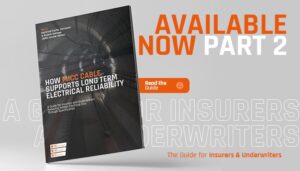 Wrexham Mineral Cables (WMC) has published the second guide in its Insurer Series, expanding the risk conversation beyond fire to address non-fire electrical failures that drive claims, downtime, and long-term exposure in commercial buildings. As a leading manufacturer of Mineral Insulated Copper Clad (MICC) cables, WMC’s new guide explains how informed cable specification can reduce risk by design rather than relying on mitigation measures.
The WMC Insurer Series has been developed to support technical and non-technical stakeholders in understanding how electrical infrastructure affects building resilience, claims exposure, and long-term risk predictability.
Titled Electrical Faults, Corrosion & Rodent Damage: The Hidden Threat to Circuit Reliability, WMC’s new guide is aimed at insurers, underwriters, and risk consultants. It examines how everyday electrical failure modes undermine building reliability and how cable specification influences long-term risk predictability, not just compliance at installation.
Part 2 follows the success of the first guide in the WMC Insurer Series, released in November 2025, which focused on fire resilience and life safety. This new publication explores failure mechanisms that are often less visible, harder to model, and more difficult to manage through inspection alone.
The guide explains why a significant proportion of electrical-related claims arise without any fire being present. It highlights how insulation degradation, mechanical stress, moisture ingress, corrosion, and rodent damage contribute to outages, equipment damage, and business interruption. Many of these failures are latent. They develop slowly and may remain hidden until loss occurs.
What readers will learn
The guide provides insurers and risk professionals with practical insight into:
- Why electrical faults, corrosion, and rodent damage are persistent and under-recognised drivers of claims and disruption
- How polymer-insulated cables degrade over time and how this increases failure risk
- Why compliance at handover does not guarantee predictable performance over the life of a building
- How cable construction influences long-term reliability, maintenance burden, and reinstatement exposure
- How specification decisions can support more confident underwriting and more stable risk profiles
The publication also sets out the insurance relevance of these risks. It explains how latent electrical faults complicate risk modelling, increase claims frequency and severity, and drive unplanned intervention and reinstatement costs
Supporting informed specification
“Fire survival is only part of the picture for insurers,” says Gareth Edward, Commercial Manager at Wrexham Mineral Cables. “Our new guide looks at the everyday failure modes that quietly erode reliability over time. We wanted to show how informed cable specification can reduce uncertainty, improve asset resilience, and support more predictable underwriting outcomes. I hope readers will agree that we have delivered on our intention.”
As in Part 1, WMC’s guide positions Mineral Insulated Copper Clad (MICC) cables as a proven means of reducing vulnerability at source. By addressing insulation ageing, environmental degradation, and physical damage through construction, MICC supports long-term circuit integrity and more stable performance.
The guide is available to download here


