





The Power Behind the Purchase
Posted by: electime 25th November 2026

Author: Michael Beagan, Managing Director at TES Power, the Northern Ireland power distribution manufacturer and part of the Legrand Group.
On Black Friday 2025, UK shoppers spent £1.16 billion online, making it the single biggest online shopping day of the year according to Adobe Analytics. Online spending across the full Cyber Weekend reached £3.8 billion.
Every Black Friday, retailers obsess over basket sizes and conversion rates. Far fewer people give any thought to the electricity that makes each of those transactions possible. Yet the biggest shopping day of the year is, in effect, an annual stress test for the UK’s digital infrastructure. Every payment confirmation and delivery notification relies on data centres supported by a continuous, carefully managed supply of power. The day runs on something nobody can add to their basket, and the infrastructure that delivers it is engineered long before the first deal goes live.
Behind the Buy Button
Every click has a physical connection, even if the shopper never sees it. Mobile devices accounted for 61.5% of UK online spending over the 2025 festive period. The moment someone taps to pay on their phone, a request leaves the handset and travels across networks to a retailer’s platform hosted in the cloud or colocation facility. Within seconds, that single purchase can pass through several more data centres as the payment is authorised and stock systems update inventory before an order confirmation lands back on the screen.
Inside each of those facilities, power makes a journey not unlike the parcel the shopper has just ordered, passing through a series of handover points before it reaches its destination. Power arrives from the utility at high voltage, is stepped down by transformers and then distributed through low voltage switchgear to uninterruptible power supply (UPS) systems, power distribution units and finally the racks themselves. Switchgear sits at the centre of that chain, routing power safely around the facility and isolating faults before they can spread. Shoppers experience a smooth checkout, but that checkout is only as dependable as the weakest point in the power path behind it.
The Cost of a Lost Second
Online shoppers have come to expect services that simply work at any hour and under any load. When a checkout page stalls on a peak trading day, customers rarely wait around for it to recover, and anyone who has watched a payment wheel spin during a flash sale will understand why. Baskets are abandoned and the sale moves to a competitor, often taking the customer’s future loyalty with it. For payment providers and banks, even a short interruption can ripple outwards to thousands of businesses that depend on them.
 The consequences of downtime are not theoretical. UK consumers have already experienced the disruption first-hand. Data published by the Treasury Committee showed that nine of the country’s largest banks and building societies recorded at least 803 hours of unplanned IT outages between January 2023 and February 2025. Those incidents had a range of causes, yet together they show how quickly downtime turns into financial and reputational cost. Within the data centres that host these services, industry research from Uptime Institute consistently identifies power as the leading cause of impactful outages, and a failure during the busiest trading window of the year is considerably harder to recover from.
The value of reliable power is easy to overlook precisely because, when it is engineered well, nobody notices it. Much like the plumbing in a house, it only tends to attract attention when something goes wrong.
Engineering Resilience From Day One
The most dependable data centres treat resilience as a design requirement from the first drawing, beginning with a clear understanding of how power will flow through the facility under normal conditions and how it will behave when something goes wrong. Fault levels are highest closest to the power source, so each switchboard must be specified for the electrical conditions at its exact position in the system. A board rated for the wrong fault current is either an unnecessary cost or an unacceptable risk.
Protection coordination is equally important. A properly executed discrimination study ensures that, if a fault occurs on one branch of the system, only the breaker serving that branch trips while the rest of the facility keeps running. Redundancy then provides an alternative route to the critical load, with dual power paths and backup sources ready to take over without interruption. The most effective designs focus that redundancy on the critical power path, where a failure would immediately affect the IT load, so that investment goes where it delivers the greatest protection.
Demand on that infrastructure is also changing. Adobe reported that traffic to UK retail sites from AI sources grew 329% year on year over the 2025 festive period with shoppers, it seems, are more than happy to let a chatbot do the bargain hunting. Beyond the increase in traffic, AI workloads place unique demands on electrical systems, drawing power in steep, rapid spikes that place new stress on UPS systems and switchgear. Power systems designed today need the headroom and flexibility to absorb that volatility during the busiest hours of the year.
Ready Before the Rush
A well-designed power system still has to be proven before it carries a live load. Traditionally, switchgear and UPS equipment arrived on site from separate suppliers and were integrated and tested under significant time pressure during construction. Each additional interface between components introduced another opportunity for error, and problems discovered at the commissioning stage are the most expensive and disruptive to put right.
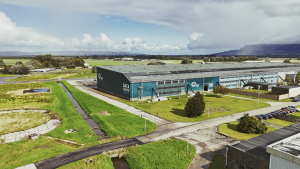
Modular electrical rooms and skid-based power solutions move much of that integration and testing into a controlled factory environment. At TES Power, systems are fully assembled and put through Factory Acceptance Testing at our 300,000 sq ft manufacturing campus in Ballykelly before they ship, so operators know the equipment performs as specified before it ever reaches site. Building Information Modelling (BIM) supports precise coordination with wider site services, and because manufacturing runs in parallel with civil works, rigorous testing does not come at the expense of programme time.
That level of pre-validation reduces commissioning risk on site and gives operators far greater confidence that their power infrastructure will behave as intended on the day it matters most.
A Business-Critical Investment
The pressure on online services will only grow as digital commerce expands and peak trading days set new records year after year. Behind every one of those transactions sits a chain of physical infrastructure that has to perform without interruption, and the power distribution systems at its heart deserve the same strategic attention as the platforms they support.
Investing in robust electrical design and thorough testing protects revenue and customer trust long before a shopper reaches the checkout.
In a digital economy where every second counts, reliable power remains one of the most important and least visible business-critical assets. The operators who plan for failure at the design stage are the ones whose customers never notice it. Shoppers will remember the deal they got. The best power infrastructure makes sure that is the only thing they remember.


