







Automating Brewery Processes with Sophisticated Modular Systems
Posted by: user_amy 21st September 2026
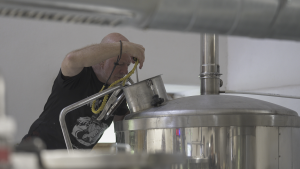
What happens when modern process automation technology meets stone-built production premises dating from the Middle Ages?
The answer is a product, craft beer, of exceptional quality and unique character, made by a brewery which is set for a sustainable future and growing revenues. But achieving this outcome required a sensitive and carefully calibrated approach to implementing automation technology – an approach to which the modular products and collaborative culture of WAGO were well suited.
21st Century Equipment in a 14th Century Building
The brewery in question, Orm’s Brewhouse, operates out of 14th century farm buildings on the Ormside Hall Estate in rural Cumbria, in northern England on the fringes of the scenic Lake District. Its location is rich in history, but presents difficulties for operators of modern manufacturing equipment and processes. A five-barrel (5BBL) craft brewery founded in 2025, Orm’s Brewhouse has embraced the challenge of preserving the buildings’ traditional character.
But the difficulty of operating in premises from another age militates against the brewery’s ambition to create the perfect pint. Director Ian Purves insists that the brewery has to respect the ‘soul’ of the place where the beer is made. After all, the age and history of the premises underpin the Viking story that the Orm’s Brewhouse brand tells its customers. But as Ian says, ‘We were working against the building, not with it.’
When Orm’s Brewhouse was founded, the ancient building was equipped with refurbished vessels, pumps and extraction pumps. Mechanically, the system was sound. From a control and automation perspective, however, it was extremely limited. The control panel offered little more than basic start/stop functionality: it provided for no recipe management, no automated dosing, no alarms and no meaningful process feedback. Critical brewing stages relied heavily on manual intervention. Volumes were estimated, temperatures adjusted by experience rather than data, and additions timed manually.
This created the risk of inconsistent beer quality, wasted water and ingredients, unnecessary energy use and limited scope to scale production with confidence. Just as important was the effect on the people at the centre of the operation – the brewing team. As brewer Chris Stanley says, everything was a manual process, from monitoring thermometers to guessing volumes of mash. ‘You were so busy fighting the equipment that you lost sight of the craft,’ he says.
Combining Modern Process Control With Legacy Equipment
Purves and Stanley knew that automation could solve the problems which the ancient building put in their way. Done the right way, automation would:
- Improve accuracy and repeatability without removing brewer control
- Reduce risk and stress on brew day, while providing visibility into what the process is actually doing
- Keep the system flexible, open and future proof
The automation system which would provide these benefits needed to be open and modular, so that the brewery could retain existing systems. This was a sensible approach for a small craft brewery to take, since it avoided the high up-front capital cost entailed in discarding equipment before the end of its useful life and replacing it with an all-new solution.
This decision to, as Ian Purves describes it, ‘build on what we started with’ was in tune with the ethos of WAGO’s engineers, who are experienced in implementing modular systems which combine best-of-breed equipment from multiple vendors. Ian Purves, who noticed the difference between WAGO and large automation system integrators, says ‘The WAGO engineers did not come to us with a product catalogue, they came for a conversation.’
WAGO’s application engineering team began with a site visit, working closely with the brewers to understand the process, the constraints of the historic estate and the brewery’s long-term ambitions. Together with Orm’s Brewhouse, they decided that the brewery had three main requirements of the automation system:
- Automated temperature control
- Visualisation of the processes
- Harnessing process data to enable continuous improvement and quality control
The WAGO solution combined new hardware with a software system which both controls the process and provides graphs, numeric read-outs and other visualisations which can be viewed both on-site and remotely.
A New Open, Scalable Brewery Automation System
At the heart of the upgrade was the replacement of the legacy controller with a WAGO PFC100 programmable logic controller (PLC 750-8112), which handles OPC UA, MQTT, Modbus, Ethernet IP and many other protocols. This broad support for standard industrial control technologies provides a foundation for future expansions of the system, as well as improving connectivity and monitoring capability.
To bring real insight into the brewing process, IO-Link smart temperature and other sensors from Endress+Hauser were integrated via a WAGO IO-Link Master module (750-1657). Together, the PLC and IO-Link Master provide a complete data chain from the temperature and flow sensors all the way to the cloud. This connectivity benefits from VPN firewalls and integrated cybersecurity protection to ensure that process-level components can safely be linked to higher-level systems and to the internet to enable remote access.
Now for the first time, accurate measurements of flow, temperature and viscosity were available in the brewhouse or remotely via the cloud, alongside reliable volume measurements available throughout the process.
This meant that the most important parts of the brewing process were automated:
- Automated Hot Liquor Tank (HLT) temperature control, compensating for ambient conditions
- Precise water dosing using flow sensors
- Safety cut-offs and alarms to protect equipment and prevent unplanned downtime
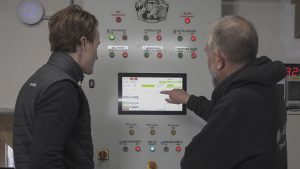
The control software was engineered from the ground up around Orm’s actual brewing process, rather than forcing it to fit a generic template. Alongside the automation equipment, a new Web Panel 400 10.1” display provides clear visibility of each brewing stage, giving brewers confidence in what the system is doing at all times.
Chris Stanley was immediately struck by the way automation was going to transform his craft. He says: ‘The first time that I saw the flow meter hit the target and the pump just automatically stop, I realised just how precise we could make the whole brewing process.’
Data-driven Brewing Replaces Guesswork
The upgraded system supports recipe entry and storage, visualisation of water dosing during mashing, and automated prompts for key additions during the boil. Critical process parameters are logged, creating a growing dataset which supports consistency and continuous improvement. Temperature control during fermentation, often spanning several days, is now fully automated, including a controlled step-down chilling process at the end of fermentation to protect yeast health. When it comes time to rack, brewers know exactly how much beer is available, allowing the correct number of casks to be cleaned and prepared in advance.
Remote connectivity configured by the Orm’s Brewhouse team allows WAGO engineers to provide support and troubleshooting without the need for site visits. This is a major advantage for a rural brewery.
Chris Stanley concludes: ‘Efficiency isn’t just about saving time or ingredients — it’s what allows a small brewery like ours to grow. With WAGO’s automation in place, we finally have the visibility and control we need to trust the process from start to finish. It gives us more concentration time to get the recipe right, to stop processes at the right moment, so that when we get the brew in the fermenter, it’s the best that it can be.’
The Result: Energy Efficiency, Sustainability and a Future-Ready Platform
Since the upgrade, Orm’s Brewhouse has gained a far higher level of confidence in its brewing process. Improved temperature control has significantly increased consistency, automation has reduced waste and manual intervention, and brew days are shorter and less stressful.
Energy efficiency has also improved. Automated pump shutdowns, timed HLT heating and better process visibility have reduced unnecessary runtime, lowering both energy consumption and operating costs. Crucially, the modern control platform provides a foundation for future optimisation.
The brewery already operates a large on-site solar installation, and has written code to enable surplus solar generation to be diverted into heating the HLT. Electricity worth around £0.08 per kWh when exported from solar sources can instead offset heat that would otherwise cost around £0.24 per kWh to buy from the brewery’s energy supplier. This capability is only possible because the open control system has been designed from the outset to enable extension over time.
A Long-term Partner in Automation
The solution for Orm’s Brewhouse worked so well in part because of the modularity of the equipment available from WAGO and others. But it was just as much to do with the nature of the collaboration between customer and supplier.
WAGO’s open approach allowed the WAGO PLC and control architecture to be engineered around the brewery’s real process, ensuring accuracy, repeatability and long-term flexibility. As a vendor-agnostic automation provider, WAGO seamlessly integrated IO-Link sensors from third-party suppliers alongside existing equipment, protecting the brewery’s prior investment while enabling modern, data-driven brewery automation. The modular, scalable architecture devised by WAGO ensures that the system can evolve as production volumes grow, recipes change, and the brewery implements new methods for optimising energy generation and consumption.
Underpinning all this technology, however, is a relationship: WAGO’s application engineering team worked directly with the brewers, combining their deep automation expertise with Purves’ and Stanley’s hands-on understanding of the brewing process, to produce a robust, future-ready system that the brewing team can trust.
As John Mackey, Head of Automation Sales at WAGO UK & Ireland, says, ‘For WAGO, what makes this a moment of success is seeing the focussed application of automation to help the company deliver on its goal of creating a really high-quality beer. Together we have married the craft and artisan element of the brewing process with modern automation for data harvesting and quality control, which is ultimately what is going to enable Orm’s Brewhouse to develop as a business.’


