








Thorn NightTune brings a lighter touch to Carlisle’s new Southern Link Road
Posted by: user_amy 7th October 2026
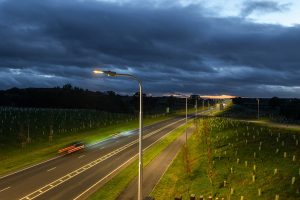
An 8km strategic road through the Cumbrian countryside called for an approach to lighting that considered what lay beyond the carriageway as carefully as the road itself. Thorn Lighting has supplied 379 R2L2 luminaires with NightTune technology for the new Carlisle Southern Link Road, balancing highway safety with energy efficiency, dark sky protection and the needs of nocturnal wildlife.
A new road inevitably changes the landscape around it. At night, that change can extend much further than the carriageway itself.
That consideration was particularly important for the Carlisle Southern Link Road (CSLR), a new 8km route connecting Junction 42 of the M6 with the A595 at Newby West. Passing predominantly through Cumbrian countryside, the road forms part of a £259.4 million infrastructure investment designed to improve connectivity, reduce congestion and support future economic and housing growth around Carlisle.
For Cumberland Council, providing safe, compliant lighting for drivers and users of the associated shared-use routes was only part of the brief. The council wanted to minimise the effect of artificial light on the rural environment and its nocturnal ecology.
The result is one of Thorn Lighting’s most ambitious applications of NightTune technology to date.
A different approach to major road lighting
The easiest solution would have been conventional LED road lighting operating at a fixed colour temperature.
Cumberland Council wanted to go further.
From the outset, the lighting team challenged Thorn to develop a scheme capable of meeting the safety and performance requirements of a major road while responding more sensitively to the surrounding environment.
Craig Lensky, Key Account Manager, Outdoor Lighting at Thorn Lighting, explains:
“What makes this project particularly interesting is that ecology wasn’t treated as something to consider once the road lighting had been designed. It was part of the lighting brief from the beginning. We had to provide the right light for people using a major new road but also think very carefully about what that light was doing beyond it and throughout the night.”
That principle reflects the wider approach taken to the route. Cumberland Council incorporated walking, wheeling and cycling infrastructure alongside the new road,
while a section of the shared-use path across the Caldew Crossing was deliberately left unlit for environmental reasons.
NightTune: changing light as the night changes
Thorn supplied 379 R2L2 small and medium road lanterns, covering lumen outputs from approximately 1,800 to 30,000 lumens and wattages from 20W to 260W.
But it is what happens inside the luminaires that makes the scheme different.
NightTune changes both the intensity and colour temperature of the lighting as the night progresses. From dusk until 9pm, the Carlisle scheme operates at 2700K and 100% output. Between 9pm and midnight, output reduces to 50% and the light warms to 2400K, before reaching 2200K between midnight and 5am. As activity begins to increase towards morning, the process reverses, returning through 2400K before reaching 2700K and full output from 6am until dawn.
This matters because reducing light output and moving towards warmer light reduces the amount of shorter-wavelength blue light introduced into the nocturnal environment. Thorn’s NightTune research describes this combination of lower intensity and warmer colour temperature as a way of better balancing human requirements with the needs of surrounding ecology.
Designing rather than compromising
Applying NightTune across a major road scheme was not simply a case of specifying an existing lantern.
Using R2L2 as the platform, Thorn developed several customised optical variants to achieve the required road lighting levels while accommodating the changing NightTune colour-temperature mix.
During the design process, fixed-colour-temperature alternatives were considered as a way of simplifying the scheme. Cumberland Council remained committed to the NightTune approach.
That decision required additional lighting design and product development but enabled the environmental ambitions of the project to be retained without compromising the required highway lighting performance.
Craig continues:
“There were easier ways we could have approached the design, but the council had a very clear ambition. They wanted this to demonstrate how major road lighting could be delivered differently. Our job was to make that ambition technically achievable, rather than dilute it to make the design simpler.”
Less light when less light is needed
NightTune also contributes directly to the energy performance of the installation.
Rather than operating every luminaire at full output throughout the hours of darkness, light levels reduce as traffic and pedestrian activity falls. Thorn’s NightTune
methodology therefore addresses two environmental considerations simultaneously: how much light is being used and the spectral composition of that light.
Thorn’s comparative spectral analysis provides another important measure. Against a fixed 3000K dimmable solution following an equivalent dimming programme, a NightTune cycle produces an average blue peak 13% lower and overall low-wavelength output 18% lower.
The R2L2 installation has also been designed at zero tilt. R2L2 is independently DarkSky Approved at colour temperatures of 3000K and below when installed within the approval conditions, supporting the project’s objective of limiting upward light and protecting the night sky.
Adam Williamson BA (Hons) CMgr MCMI AMILP, Lighting Manager, Highways Assets and Strategy at Cumberland Council, comments:
“The Carlisle Southern Link Road gave us an opportunity to think differently about how a major new highway should be lit. Safety and compliance were fundamental, but given the predominantly rural setting, we also wanted to minimise the impact of artificial light on the surrounding landscape and nocturnal environment. NightTune enabled us to bring those objectives together, adapting both light levels and colour temperature through the night rather than accepting a fixed approach. The finished scheme demonstrates that high-quality highway lighting and environmental responsibility can go hand in hand.”
The Carlisle Southern Link Road opened to traffic in June 2026. Its lighting now changes with the rhythm of the night: providing light where and when people need it, reducing output when activity falls and shifting towards warmer light when the surrounding nocturnal environment is at its most active.
For Thorn, it represents a significant demonstration of what NightTune can achieve at scale. For more information about Thorn Lighting’s urban and architectural lighting solutions, please visit Thorn Lighting.


