





Major milestone for Warrington battery energy scheme powering 250,000 homes
Posted by: electime 9th November 2026
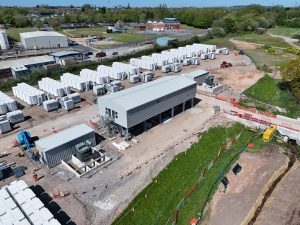 A new battery energy storage system (BESS) being built on the former coal power station at Fiddler’s Ferry has passed a major milestone with the installation of key electrical equipment.
The site is owned by SSE Renewables, with infrastructure specialists OCU Energy and Fluence building the 150 MW BESS. When complete, it will be capable of providing power for approximately 250,000 homes for a two-hour period at a time.
An SSE Renewables spokesperson previously said: “Similar to our Ferrybridge project, our grid-scale battery at Fiddler’s Ferry will be built on what was a former SSE-owned coal-fired power station and highlights the transition away from fossil fuels towards a net zero future.”
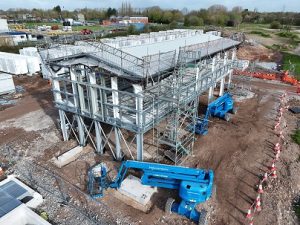
Kiosk buildings, which will house electrical relays, switchgear, control panels and communication systems, are now in place, fabricated by RSK Group companies AJ Engineering & Construction Services and Northern Engineering & Welding Co (NEWCo).
AJ Engineering & Construction Services Pre-Construction Manager Lee Binks said: “When fully operational, the BESS site will store power for release back to the UK national grid when it is needed the most – helping to manage peaks of energy demand and supporting a transition away from fossil fuels.
“We have designed, fabricated and cladded two auxiliary transformer buildings and one portable relay room for the site in a modular format, reducing the time spent on-site. These buildings provide compact, weatherproof enclosures that house the equipment that ultimately connects the battery system to the national grid. In addition to this, we have fabricated and erected the switch room, which is a structural steel portal frame building with insulated cladding.
“Usually, for the aux buildings and portable relay rooms, these types of small buildings are manufactured using glass reinforced plastic or brick and built on-site. To speed up delivery and reduce complexity, we built them off-site using fabricated steel modules. They were then transported to the site and lifted into place, already cladded and ready for fit-out.”
Lee explained that because they are widely used in both the water and the energy sectors, they are in high demand, and lead times for their procurement can be significant.
He said: “Having been built with steel and cladding, the kiosks were ready to be installed on-site within six weeks. Normally this team of structural designers, detailers, fabricators, steel erectors and site management would have to do this on-site. By building the kiosks off-site, we have avoided adding further complexity to an already busy construction site.”
Fellow RSK company Acies carried out the connection design on the structural frame for the switch room, working in collaboration with AJ Engineering while it carried out the modelling of the building.
With the kiosks in place, OCU Group will begin the fit-out process of the internal equipment that will connect the site to the national grid. It is expected to be operational in 2027.


