





Behind the Build: Engineering a Safer, Smarter Grain Storage Facility at the Port of Tilbury
Posted by: electime 10th November 2026
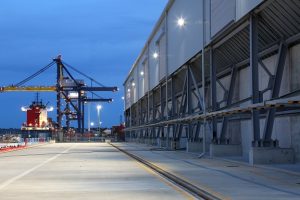 Dialight, the global leader in industrial and hazardous-area LED lighting, has played a key role in the development of the new Cefetra Bulk Store at the Port of Tilbury in Essex, delivering a comprehensive lighting solution designed to meet the demanding safety, environmental and operational requirements of a busy port environment.
Working closely with principal contractor Harmonix Construction and the Port of Tilbury, Dialight developed a tailored lighting scheme incorporating more than 200 luminaires across the internal grain storage areas, quayside, external operational spaces and associated facilities. With combustible grain dust, exposed marine conditions, challenging mounting heights and complex lighting requirements to consider, the project called for specialist technical expertise and a carefully coordinated approach from the outset.
Completed in July 2026, the new facility at Berth 43 has transformed a former open-air container depot into a purpose-built storage operation with capacity for approximately 50,000 tonnes of soya and 10,000 tonnes of wheat-feed pellets. The project also demonstrates how early engagement with a lighting manufacturer can help optimise a specification, improve design efficiency and deliver reliable long-term performance in challenging industrial environments.
We speak to Aidan Brown, UK/EIRE Sales – EMEA at Dialight; Jenis Mistry, Project Engineer at the Port of Tilbury; and David Thrower, Project Director at Harmonix Construction, to explore the technical challenges, design decisions and collaboration behind the project, and the important role lighting plays in supporting safe and efficient port operations.
What prompted the development of the new Cefetra Bulk Store, and what were the Port’s main objectives?
 Jenis Mistry, Port of Tilbury: The Port has supported Cefetra’s animal-feed operations since 1997, historically using 5/6 Shed for the discharge, storage and onward distribution of soya bean meal.
The relocation was prompted by the adjacent third party operation requiring additional space, including the existing Cefetra shed. This created the need for a replacement facility at Berth 43 that could maintain continuity of the Port’s established animal-feed service while supporting its wider development plans.
Our priority was to create a modern, purpose-designed bulk store that would improve safety, operational efficiency and long-term maintainability.
The development needed to accommodate significant storage capacity alongside the infrastructure required for day-to-day operations, including vehicle access, entry and exit weighbridges, welfare facilities, electrical services and provision for a future rail-mounted hopper.
Equally important was ensuring that the project could be delivered without unnecessarily disrupting neighbouring port activities, which needed to remain operational throughout construction.
From a construction perspective, what made this project particularly challenging?
 David Thrower, Harmonix Construction: As the design-and-build contractor, our responsibility was to take the Stage 4 design through to construction and completion, coordinating everything from enabling works and the building structure through to electrical installation, external infrastructure and final handover.
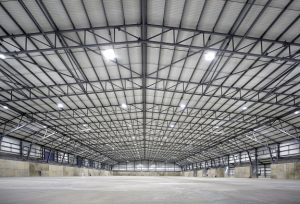
One of the biggest structural challenges was achieving a clear span across the building’s 75-metre width without intermediate columns. This required a substantial steel truss frame, installed using tandem crane lifts after construction of the six-metre-high concrete retaining wall.
Buildability and sequencing were therefore critical considerations. We worked closely with our steel frame contractor and adjusted the piling sequence so that the internal slab piles could be installed after the frame had been erected, keeping the erection area free of obstructions.
The enabling works were also complex, including the demolition of a redundant lighting mast and the phased relocation of the Thames Clippers maintenance shed. We had to construct its replacement before demolishing the existing facility to make way for the grain store.
Below-ground obstructions created additional challenges, requiring us to resequence the unexploded ordnance survey and piling operations. However, close coordination between the teams enabled us to adapt while maintaining progress against the programme.
Why did the grain storage environment demand such a specialist approach to lighting?
Aidan Brown, Dialight: Grain storage facilities present particular challenges because airborne combustible dust can create potentially explosive atmospheres. The internal storage areas at Berth 43 were designated Zone 22 hazardous areas, meaning the lighting equipment needed to be appropriately certified and suitable for that environment.
Dust accumulation is another important consideration. Over time, dust can settle on luminaires, so the suitability of the equipment and ongoing inspection and cleaning requirements need to be considered.
The location also added another layer of complexity. Port environments are exposed to wet and demanding marine conditions, so we needed luminaires capable of withstanding those conditions while providing reliable illumination.
Beyond the hazardous-area requirements, the design had to address the different activities taking place across the facility. The internal grain store, external operational areas, quayside and vehicle refuelling point each had their own requirements.
It was not simply a case of achieving a uniform level of illumination. We needed to understand how each area would be used and select the most appropriate lighting solution accordingly.
How did Dialight approach the lighting design, and what influenced the final product selection?
Aidan Brown, Dialight: We became involved at an early stage, initially engaging with Harmonix Construction in November 2024. Once the construction drawings and the Port’s lighting specifications were available, we could begin developing the scheme around the operational requirements of the building.
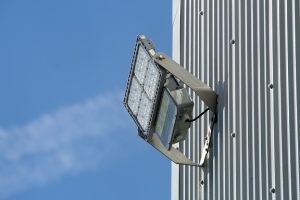
One of the most significant developments was the decision to use our ProSite Floodlights within the grain store.
Our initial design was based on 110 SafeSite High Bay luminaires. However, the wider range of optical distributions available with the ProSite Floodlight allowed our designers to refine the arrangement and reduce the number of fittings to 78, while still maintaining the specified light levels.
This was an important achievement because it demonstrated how careful optical selection and lighting design could reduce the quantity of equipment required without compromising the intended performance.
The project represents a large-scale deployment of ProSite Floodlights in a hazardous-area application.
Across the wider site, the installation incorporates more than 200 Dialight luminaires, including ProSite Floodlights, SafeSite luminaires, Emergency GRP Linears and Vigilant Bulkheads, selected to meet the differing needs of the facility.
What were the most important lighting requirements from the Port’s operational perspective?
Jenis Mistry, Port of Tilbury: The lighting needed to support safe, reliable operations across a wide variety of environments, rather than just the main storage building.
This included the internal store, lorry tunnel, external perimeter, mobile-hopper area, access doors, escape hatches, welfare parking, fuel and washdown areas.
Within the hazardous areas, equipment needed to be suitable for Zone 22 conditions and protected against dust ingress. Emergency lighting also had to provide appropriate coverage for escape routes.
For external operational areas, the specification called for an average illumination level of 20 lux, with a minimum of 5 lux. These requirements were important in supporting visibility and safe movement around the site.
We also needed to consider how the lighting would be operated and maintained, including manual overrides, periodic-test switches and appropriate energy-saving switching or dimming arrangements.
The objective was to create an integrated lighting solution that met the operational, safety and maintenance requirements of the facility as a whole.
Were there any particular challenges in achieving the required illumination across such a large building and its external areas?
Aidan Brown, Dialight: The scale and layout of the building created several design challenges.
The mounting heights meant that careful positioning and alignment of the luminaires were essential, particularly for the installation team, who needed to maintain consistent fitting levels across the structure.
We also had to account for the shadowing created by the large traversing cranes operating within the facility. These can obstruct light distribution, so their impact needed to be considered during the design process to maintain adequate illumination.
Externally, there were specific lighting requirements around the quayside and water’s edge, which needed to be incorporated alongside the wider operational lighting.
This is where detailed lighting calculations and appropriate optical selection become particularly valuable. Rather than simply increasing the number of fittings, we could consider how the light was distributed and position the luminaires to achieve the required results.
How important was collaboration between the three organisations throughout the project?
David Thrower, Harmonix Construction: For the lighting package, early engagement and clear communication were fundamental to its successful delivery.
Dialight’s designers were responsive and thorough, working closely with us as the construction design developed and responding to changes in the building and external areas.
That support extended beyond the design itself. Dialight helped ensure that the correct fittings were available on site and responded promptly whenever replacement products were needed.
By placing orders early and coordinating deliveries well ahead of installation, we had greater certainty when planning the work.
One of the most satisfying aspects of the completed project was the straightforward, efficient and friendly communication between the client, suppliers and subcontractor team. That collaborative approach helped us resolve issues quickly and deliver the project on time, on budget and to an exceptional standard of quality.
Jenis Mistry, Port of Tilbury: The collaboration brought together three different areas of expertise.
The Port established the operational and safety requirements, Harmonix coordinated the design-and-build process, and Dialight provided specialist lighting design and product knowledge.
Regular project meetings enabled us to review lighting zones, installation interfaces, testing requirements and any technical issues as the project progressed.
Importantly, this meant that lighting was considered as part of the wider facility rather than as an isolated package. That approach helped ensure the final installation was aligned with the building’s intended operation and long-term requirements.
How does the lighting installation address the challenges of long-term maintenance and reliability?
Aidan Brown, Dialight: Long-term performance is particularly important in industrial facilities where access can be difficult, disruptive or potentially hazardous.
Our standard industrial luminaires have a rated life in excess of 150,000 hours and are backed by a ten-year warranty. In a large grain store, where fittings are installed at considerable heights, reducing the frequency of replacement can offer significant practical advantages.
It is also important to distinguish between the main luminaires and emergency lighting equipment. Emergency lighting batteries have a shorter service life and will typically require replacement every four to five years, so these need to be incorporated into the facility’s ongoing maintenance programme.
The wider considerations include the robustness of the equipment, its suitability for the environment and the importance of regular inspection.
For demanding industrial applications, the objective is to provide reliable lighting that continues to perform over the long term while minimising the need for unnecessary maintenance interventions.
What does the completed facility mean for the Port of Tilbury’s future operations?
Jenis Mistry, Port of Tilbury: The completion of the new bulk store provides the Port with modern infrastructure that will support the Cefetra operation over the longer term.
Relocating the activity to Berth 43 allows the existing area to accommodate the planned expansion of the neighbouring third party operation while preserving an important part of the Port’s established business.
The new facility also provides the infrastructure for a rail-mounted Eco Hopper, modern weighbridges and integrated operational systems, supporting improvements in efficiency, safety, dust control and maintainability.
From a lighting perspective, we now have a coordinated installation that provides high-level illumination within the main storage space, appropriate hazardous-area equipment, emergency coverage and external operational lighting.
It is an important part of creating a safer, better-lit working environment that supports the facility’s intended use.
Finally, what lessons does this project offer for other industrial facilities with complex lighting requirements?
Aidan Brown, Dialight: The most important lesson is the value of involving the lighting manufacturer as early as possible.
When a project includes hazardous-area classifications, challenging environmental conditions and multiple operational requirements, early engagement allows those factors to be considered before the design becomes too advanced.
It also creates opportunities to refine the specification. At Berth 43, for example, the use of ProSite Floodlights allowed us to reduce the number of luminaires within the grain store while maintaining the required lighting performance.
Clear requirements, close collaboration and appropriate product selection all contribute to a more effective result.
Ultimately, projects like this demonstrate that industrial lighting is about much more than simply illuminating a space. It is about understanding the environment, supporting safe operations and designing a solution that will continue to perform reliably for years to come.


